


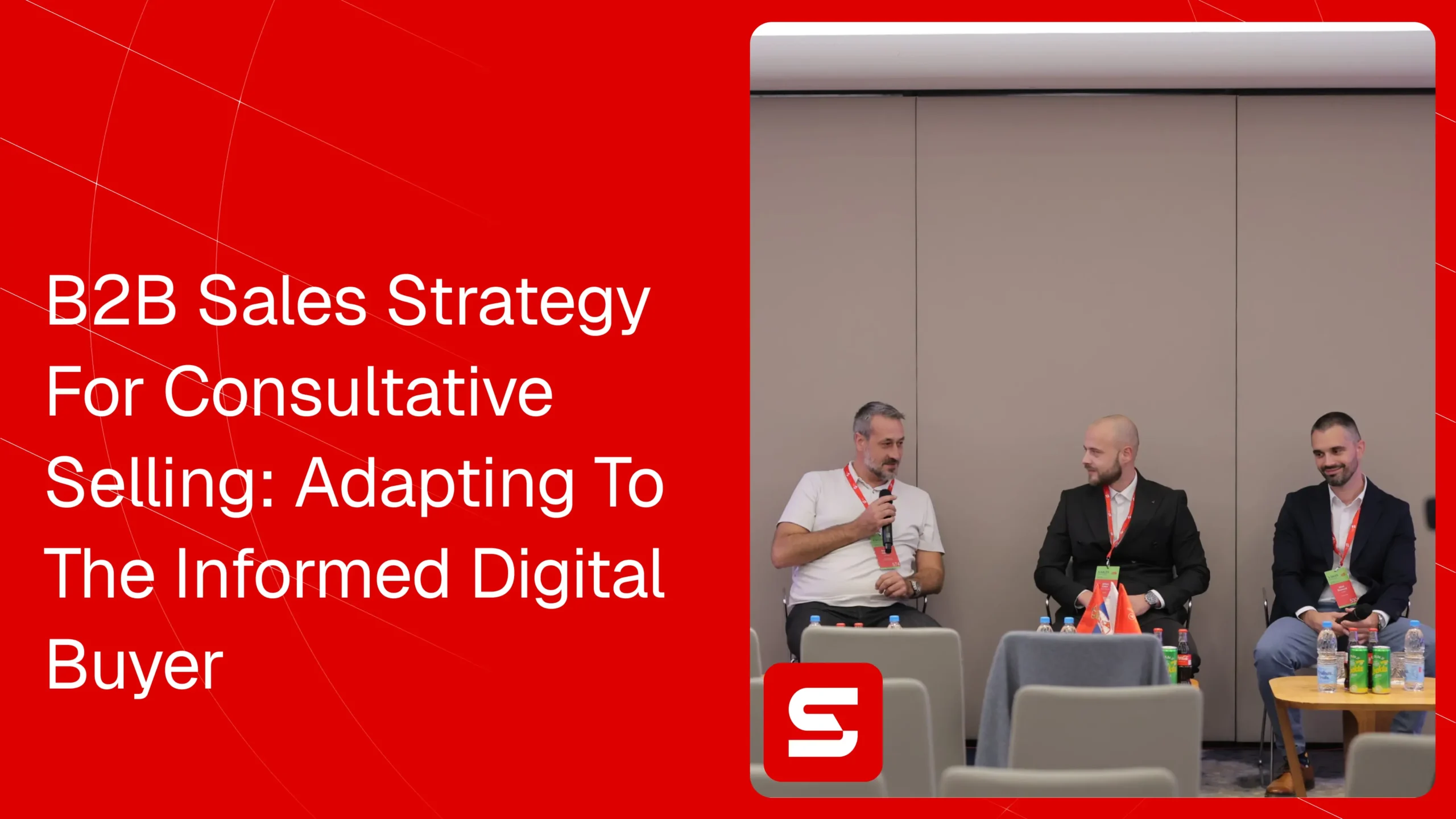
A B2B buyer today walks into the first meeting having already done the homework a salesperson used to do for them. They have compared vendors, read reviews, checked pricing, and formed an opinion before anyone from your team says a word. This was the starting point of the panel discussion we took part in at the 3rd Sales Congress, where Branko Vuković (Samsung), Milan Čekić (Santos Digital’s co-founder and CEO) and Miloš Živanović (Flaner) compared notes on what this shift means for a sales team’s daily work — not in theory, but in discovery calls, negotiation, and personalization.
Why the B2B Buyer Already Knows More Than Your Salesperson
The panel’s experience lines up with wider data: 81% of buyers now choose their vendor before any direct contact with a sales team, and buyers typically complete around 70% of their purchasing journey research before engaging a vendor at all. The first live conversation is no longer an introduction — it’s a continuation of research the buyer has already run on their own.
Branko Vuković framed this as a net positive: in his view, better access to information has sped up sales conversations and raised their quality, because less time goes into basic introductions and more into the actual pain point. He contrasted this with the pre-2010 telecom industry, when buyers had almost nothing to go on and a first meeting was mostly spent explaining what the product even was. In our experience building sales funnels at Santos Digital, that phase isn’t coming back — which is exactly why the rest of the panel focused on what a sales team needs to do differently now that information is no longer the bottleneck.
Discovery Calls With Researched Prospects: What Changes
If the buyer already knows what your product does, the discovery call has to do something else. Milan Čekić described a move away from a purely “catalog” role toward one where the salesperson actively helps the buyer see past their own barriers and understand what they actually need — closer to a setter/closer dynamic than a product demo. That matters because 85% of sales professionals say their biggest ongoing challenge is getting prospects to open up and share real business context during discovery — exactly the gap a consultative approach is meant to close.
The conversation also turned to what buyers actually want solved. The answer was blunt: generic offers don’t move the needle anymore. Buyers want a direct line to their most painful, often atypical problem — deferred payment terms, a cascading offer structure, extended warranty conditions, or something specific to how their team operates — and they’re willing to pay more for a vendor who engages with that problem directly. This tracks with the pattern that business buyers now average 16 unique interactions with a vendor before a final purchase: a single generic pitch doesn’t survive that many touchpoints.
Trust-Based Selling: Why Honesty Builds or Breaks Credibility
Asked what builds — or destroys — credibility fastest, Branko Vuković answered in one word: trust. Drawing on 15 years in B2B sales, he described trust as built slowly and lost almost instantly; once broken, it doesn’t return to the same level but has to be rebuilt higher, which takes considerably more time. His example: when a client asks whether network coverage exists in a given area and it doesn’t, the honest answer is “no, we don’t have that — but let’s talk about it,” not a deflection toward marketing claims.
This matches what buyers say they want from a vendor relationship: 84% of buyers want salespeople to act as trusted advisors, not pitch-delivery mechanisms. Miloš Živanović added that honesty alone isn’t enough — the moment and manner of asking a question matters just as much, including knowing when to slow a conversation down rather than pushing through discomfort with more pressure.
From Classic Pitching to Consultative Selling
Miloš Živanović laid out why a single pitch style no longer works in complex B2B deals: a procurement director, a finance director, a production director and sometimes a sales director can all be part of one buying decision, each carrying a different KPI — inventory turnover, cost control across locations, output targets, or something else entirely. A solution that makes the operational team’s work harder in the short term, even for a long-term gain, will stall unless the salesperson speaks to each of those KPIs individually. This mirrors the broader view that sellers increasingly add value by helping buyers make sense of what they’re already learning on their own, rather than just presenting information the buyer could find alone.
An audience question from Đorđe Todorović sharpened this: at what point should a salesperson stop negotiating and accept they might not be the right fit? The answer drew a line between negotiating and haggling — if both sides are just pulling at a number with opposing KPIs, everyone wastes time; if both sides are trying to combine goals into something workable, it’s worth continuing. The panel described walking away from a deal worth several million euros because it didn’t fit, even under pressure to accept it — the reasoning being that protecting long-term credibility matters more than closing one risky deal, and that a willingness to say no is itself a signal of integrity to future partners.
Speed vs. Quality: Responding to Buyers Who Want Instant Answers
Buyers increasingly expect a fast response, often firing the same inquiry at several vendors at once. Milan Čekić pushed back on the assumption that faster is always better: at Santos Digital, no two web design or development projects are identical, so rushing an answer can mean sacrificing accuracy for speed. A specific red flag: a prospect asking for something complex “by tomorrow” when the request genuinely requires real analysis — usually a sign the person is collecting quotes rather than seriously evaluating a purchase, and often hasn’t even done their own part of the preparation.
The urgency is real, though: nearly three-quarters of U.S. business buyers now complete their purchasing journey in 12 weeks or less, which puts genuine pressure on response time. Milan Čekić’s resolution is committing to a clear, honest deadline — “by end of day,” “by Wednesday” — rather than stalling indefinitely or rushing out a shallow answer. Getting this wrong has a cost: 58% of buyers who made a purchase in the past six months also switched vendors in that same window, which suggests a fast but low-quality first answer doesn’t buy loyalty — it just buys a short first contract.
How Much to Personalize Before It Becomes Inefficient
Miloš Živanović described sales cycles in his industry running from six to twenty-four months, with deal sizes in the millions and multiple stakeholders — in that environment, deep personalization across the organization is standard, including sometimes competing on several parallel tenders within one account to satisfy different departments’ KPIs. Milan Čekić offered the counterpoint from his own field: in tenders where 200 to 300 companies submit a bid, 185 to 190 of those submissions are essentially generic and interchangeable, which makes personalization the main lever for standing out — but forces every company to decide, deliberately, whether it is optimizing for volume or for quality.
That decision matters because buyers increasingly discount generic material on sight: 44% of buyers say they trust independent third-party content more than vendor-produced material, leaving little room for a one-size-fits-all pitch to land. At the same time, 67% of B2B buyers say they’d prefer a rep-free buying experience, and 94% already use AI tools somewhere in their purchase process — which, in our reading, doesn’t mean personalization matters less, but that it needs to be concentrated at the few points where a human conversation genuinely changes the outcome. It’s a tension we design our own lead generation and sales funnels around: automate the repetitive qualification steps, and reserve personalization for the moment a prospect is actually ready to talk.
Miloš Živanović also noted that not every stakeholder in a buying committee can be convinced, and trying to win over someone with an entrenched preference for a competitor is often not worth the time — the better strategy is identifying the genuinely undecided person and focusing energy there. Branko Vuković added a related point about global brand weight versus local flexibility: a large corporate supplier offers financial guarantees and brand recognition, while a smaller partner can swap subcontractors or compress a timeline — recognizing which factor matters most to which stakeholder is part of managing the committee. This complexity is exactly why deals stall so often industry-wide: almost 9 in 10 B2B purchases (86%) stall somewhere in the buying process, and 81% of buyers end up dissatisfied with the provider they eventually chose — numbers pointing squarely at misaligned stakeholder expectations rather than product quality.
What Separates an Average Salesperson From a Top Performer
Branko Vuković’s answer was a hiring story rather than a checklist. A candidate once came to an interview without a prepared presentation and said plainly, “I didn’t get the chance to prepare.” Branko hired him anyway — and that person went on to become the company’s best-performing salesperson for the following ten years. His point wasn’t that honesty itself was the differentiator — it was that the honesty revealed someone who listens for the whole picture rather than performing a script, a skill that transfers directly into client relationships: a client who trusts a salesperson that deeply won’t switch for a 20% cheaper competing offer.
Milan Čekić added that this shows up in how and when questions get asked — including the willingness to pause a negotiation, or to say “we’re not the right fit right now, but we might be in a year,” rather than forcing a close that doesn’t serve the client. The bar for what a human seller needs to add keeps rising, partly because buyers are now comfortable completing very large transactions with minimal human involvement — the number of B2B decision-makers willing to complete purchases of $10 million or more through ecommerce channels has surged 83% — meaning the human part of the process has to earn its place.
Key Takeaways
- Most buyers finish the bulk of their research and often pick a preferred vendor before any sales contact happens, so the first call needs to add insight, not information.
- Honesty about gaps — “we don’t have that, but let’s talk about it” — builds more credibility than overselling, and trust lost is far harder to rebuild than trust earned.
- Consultative selling means mapping each stakeholder’s specific KPI and pain point rather than running one generic pitch past an entire buying committee.
- A faster response isn’t automatically a better one; match response speed to the complexity of the request instead of rushing a shallow answer.
- Personalization is a genuine differentiator in crowded tenders, but every company needs to decide deliberately whether it is optimizing for deal volume or deal quality.
- Knowing when to say no to a deal that doesn’t fit protects long-term credibility more than closing a single problematic contract.
FAQ
Why do B2B buyers now know more than the salesperson before the first call?
Self-serve research tools, comparison sites and vendor reviews let buyers investigate a product in depth before ever speaking to a sales rep, and 81% of buyers now select their vendor before any direct sales contact. As the panel discussed, this shifts the first conversation from an introduction to a continuation of research the buyer has already done independently.
What is consultative selling in B2B sales?
Consultative selling means moving away from presenting a fixed catalog of products and instead diagnosing the buyer’s specific business problem — their actual KPI, bottleneck or pain point — and acting as an advisor who helps them reach a decision, rather than a salesperson reciting features. The panel described this as a shift from a “catalog” role to something closer to an advisory, setter-style function.
How should a salesperson respond when a buyer demands an instant quote?
According to Milan Čekić, the right response weighs urgency against the complexity of the request itself. A rushed, generic answer to a complex custom request can hurt credibility and signal that the buyer isn’t being taken seriously as a real evaluation — a clear, honest deadline communicated upfront usually serves the relationship better than speed for its own sake.
How do you sell to a buying committee with multiple decision-makers?
Miloš Živanović’s approach is to identify each stakeholder’s individual KPI and accept that some people in the committee simply cannot be convinced because of pre-existing loyalties — rather than spending equal effort on everyone, energy goes toward the genuinely undecided person, since that person is rarely the sole decision-maker anyway.
Is it ever right to say no to a client during negotiation?
Yes — the panel described walking away from a deal worth several million euros because it didn’t fit the company’s model, even under pressure to accept it. Protecting long-term credibility with partners matters more than closing a single risky deal, and a company’s willingness to say no is itself a signal of integrity to everyone it negotiates with afterward.