



If a campaign launches late, underperforms, or breaks the week it goes live, the usual suspect in most companies is “the developer.” In our experience running campaigns and rebuilding systems for B2B companies at Santos Digital, that’s almost never the real problem. One person or one small team is being asked to cover design, development, hosting, security, tracking and legal compliance at once, while sales and marketing keep adding requests on top. A website bottleneck sales performance problem rarely starts with incompetence – it starts with one person being asked to be an entire system.
What works instead is a defined sequence: planning before design, design before development, an internal review before anything goes live, and a going-live step measured in hours, not weeks, followed immediately by tracking and post-sale setup. We walked through this exact process, with real examples, at the 3rd Sales Congress.
How website bottleneck sales performance problems actually start on a Monday
A typical week in a company we work with looks like this: sales has an idea, marketing has a campaign, and both get stuck waiting on the same resource – the site. The website is usually maintained by one small team or a single person, so requests simply queue up behind whatever that person is already doing. If a campaign launches and performs well, everyone is happy to scale it. If it doesn’t, no one really asks why – the request just moves to the next person in line.
Urgent requests then compete for the same limited hours. A campaign might be scheduled to launch on a Friday deliberately, because weekend traffic and phone usage tend to be higher, but the honest answer back is often “can do it, but in three weeks.” Budgets are already approved, the offer is ready, the only thing missing is the landing page. What usually ships under that pressure is an MVP version that still needs real work.
When the campaign goes live and the numbers disappoint, sales says it built a strong offer, marketing says it built a strong campaign, and the finger ends up pointing at the one person responsible for the page. That person genuinely isn’t being negligent – they’re simultaneously handling design and development, often on the same unreviewed build, which is exactly where time and money get lost through endless revision rounds.
Why one person is never a system
A single developer can be genuinely excellent – capable of design, development, hosting, security, and even weighing in on sales decisions. But no one person is the best at every one of those disciplines at once, and treating one role as a stand-in for an entire system is where things break down.
This isn’t unique to any one company. 38% of marketers describe themselves as stretched or completely overloaded, and 40% say that overload happens often or constantly, not occasionally, but as a regular state of operating. When teams tell us why launches slip, 37% point specifically to revisions and approvals as the actual bottleneck, which matches what we see when design and development happen on the same build without a separate review step.
It goes deeper than workload. 54% of B2B marketers cite resource constraints as their primary content challenge – not strategy, not ideas, but simply not having enough hands to execute. That’s the same gap that shows up when one developer is also expected to cover QC, project management, legal updates to the offer, and hosting access, all inside the handful of days a campaign timeline allows.
The cost of a slow or rushed launch
A rushed launch doesn’t just risk missing a deadline – it carries a measurable cost once the page is live. In a large-scale study covering 30 million sessions, a 0.1 second improvement in load time lifted retail conversions by 8.4%. That’s not a rounding error; it’s a tenth of a second.
The gap compounds with scale. Sites that load in one second convert roughly three times better than sites that take five seconds, including in B2B, and e-commerce shows the same pattern, where a one-second load converts about three times better than a five-second one. Amazon’s own internal data illustrates it plainly: every additional 100 milliseconds of load time cost them 1% in sales.
Companies that have actually optimized for this see it directly in revenue. Rakuten 24 increased revenue per visitor by 33.1% and conversion rate by 53.37% after focusing on Core Web Vitals. Another retailer saw mobile transactions rise nearly 30% and sales per session rise 16%, which translated into a 7.6% sitewide conversion increase worth roughly $6 million in annual revenue.
The same friction shows up earlier in retail checkout flows, where about 70% of online shoppers abandon checkout before completing it – a benchmark from e-commerce, not B2B, but it illustrates the same principle we see in B2B sales pages: every extra second, every clunky step, every unreviewed page pushes more visitors toward leaving instead of converting. It’s also why understanding how today’s buyer actually researches and decides before contacting sales matters as much as the page itself – the site has to carry that buyer all the way through, not just attract them.
The launch process we use at Santos Digital
This is why we don’t start with design. We start with planning: who is responsible, who does what, and what timeline is realistic given the deadline that’s actually been agreed – a step we walk through in detail around the 7-minute mark of our talk at the 3rd Sales Congress. Good planning doesn’t need to be complicated or time-consuming, but it removes the ambiguity that causes a single person to end up responsible for everything, including a go-live step that takes about three to four hours once design and development are already approved – half a working day, not the weeks a rushed, unplanned launch often takes.
Going live is also not the finish line. Tracking, automations, and post-sale panels need to be set up right after launch, because that’s genuinely where the next phase of work begins – new products, new markets, new company offshoots all depend on that data being captured from day one, not retrofitted months later.
Launching imperfect and iterating: Selector AI and Vodin
Waiting for a “finished” website before launching anything is usually the wrong call. Selector AI is a clear example: the company launched with roughly 40 template pages and has since grown to around 80, continuing to raise significant funding and grow its market presence the entire time, without ever waiting for the site to be “done.” The site still isn’t finished today, and that’s the point – it iterates alongside the business instead of blocking it.
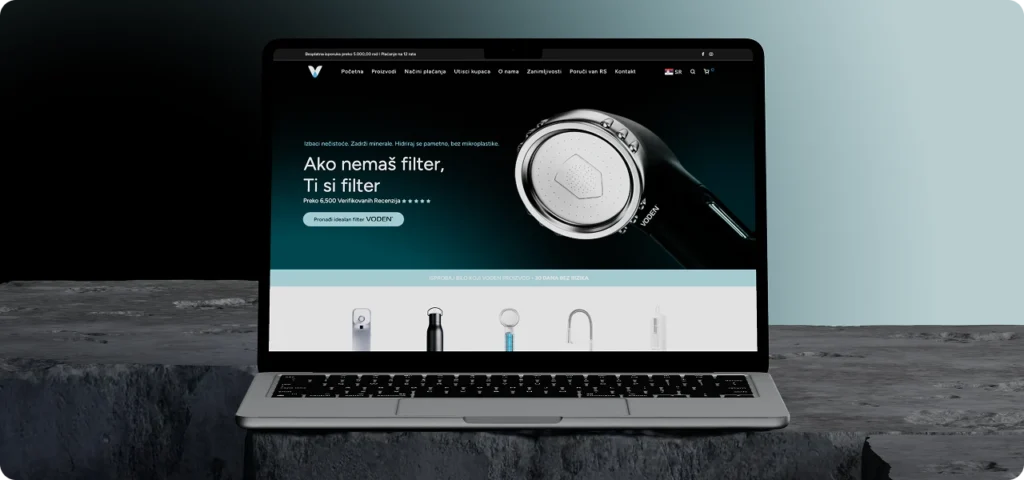
Vodin is a different kind of example, closer to home for many of our readers. We didn’t do a full relaunch – we took an existing, working system and improved it, then used that improved foundation to open new regional markets one at a time. The result of that continuous, market-by-market approach was a 62% year-over-year increase in sales, a figure that came directly from steady improvement rather than a single big redesign.
How AI search changes what a website needs to do
Getting found used to mean ads or SEO. That’s shifted. As we point out using Selector AI as an example, a Google search today surfaces an AI overview first, then sponsored results, then a map pack for local businesses, and only then organic SEO results – which on a phone means scrolling past all of that before classic search results even appear.
That means a site now has two audiences to satisfy: the person reading it, and the AI tool summarizing it. We’ve started treating this as a core requirement – being structured clearly enough that AI tools and search engines can understand what a business does and whether it’s relevant, whether that shows up in a Google AI overview or inside a chat assistant someone is using to research a purchase. This lines up with how fast the market is already moving: 80% of marketers are already using AI for content, and 75% for media production, which means the buyers researching your offer are increasingly filtering that research through AI tools before they ever reach your page. That’s also why treating the sales conversation as consultative rather than purely a pitch matters more now than it used to – the buyer has often already formed an opinion about you before a human conversation starts.
Key takeaways
- A website bottleneck almost never comes from one incompetent person – it comes from one person being asked to function as an entire system covering design, development, hosting, security, and tracking.
- Marketing overload and approval delays are common and measurable, not a sign that a particular team is uniquely disorganized.
- Speed and conversion are directly linked: a 0.1-second improvement can move conversions by single digits, and online shoppers abandon checkout at high rates when friction builds up.
- Companies that scale successfully, like Selector AI and Vodin, launch imperfect versions and keep iterating rather than waiting for a perfect relaunch.
- A website today has to work for AI tools and search engines, not only for human visitors, because AI overviews and sponsored results now sit above organic search.
FAQ
Who is responsible when something on the website breaks during a campaign?
In our process, this is defined during the planning phase, before any design work starts – so when something breaks, it’s already clear who owns the fix instead of everyone pointing at the one person who happened to build the page.
How long should it take to launch a new landing page or campaign site?
The going-live step itself only takes three to four hours once design and development are approved, but the realistic overall timeline depends entirely on how much planning happened before that – rushing the planning phase is what makes launches take weeks instead of days.
Does a slow website really affect sales, or is that exaggerated?
It’s measurable, not exaggerated: a 0.1-second loading improvement lifted retail conversions by 8.4% in a large-scale study, and Amazon’s own data showed every 100 milliseconds of added load time cost them 1% in sales.
Should we wait until our website is perfect before launching a campaign?
No. Selector AI grew from roughly 40 template pages to around 80 while continuing to raise funding and scale – proof that a company can grow substantially around a site that’s still being built out rather than one declared finished.
Is SEO still enough to get found online?
Not on its own anymore. Search results now place AI overviews and sponsored listings above organic results, which means a site needs to be structured clearly enough for AI tools and assistants to understand and recommend it, not just optimized for traditional search ranking.